Showing posts with label music theory and history. Show all posts

Wednesday, March 5, 2025

Lifespans of Composers


Verdi 88
Stravinsky 88
Haydn 77
Rossini 76
Schoenberg 76
Liszt 74
Händel 74
Bernstein 72
Wagner 69
Rachmaninoff 69
Shostakovich 68
Puccini 65
Bach 65
Berlioz 65
Grieg 64
 Brahms 63
Vivaldi 63
Dvořák 62
Ravel 62
Prokofiev 61
Satie 59
Beethoven 56
Debussy 55
Tchaikovsky 53
Mahler 50
Schumann 46
Chopin 39
Mendelssohn 38
Mozart 35
Schubert 31


Minimum, Schubert 31.
Upper Quartile, Bernstein 72
Median, between Brahms and Grieg, 63/64
Lower Quartile, Debussy 55
Maximum, Verdi / Stravinsky shared 88.

Wednesday, February 1, 2023

One Disagreement with Tommaso


musicalia:Posting link, while video in premiere : Can We Write Songs "From Theory"? [with Diana de Cabarrus] (by Tommaso Zillio) · One Disagreement with Tommaso · If Anyone Is Paranoid Enough to Believe I Compose by ChatGPT? Watch This! · Assorted retorts from yahoo boards and elsewhere: What is Music Theory, Really? Is It Any Help? Yes, If the Right One

He said Jazz, Metal, etc, could be distinguished from, not just a specific Classical style, like Baroque, Viennese Classic, Romantic, but all of common practise. I e Classical from Baroque to Romanticism.

On one item, I'd actually concede the point. Much modern popular music actually does have a direction towards the dominant rather than from dominant to tonic. But that, in turn, is a return to something which was very currently done in Medieval and Renaissance music, it was called plagal cadence.

Apart from that, and for tunes that do not use this particular conceit, I would say, common practise extends from Baroque over Romanticism, over vaudeville, to modern pop. Any type, jazz, country, schlager, metal, rockabilly, has a high degree of common practise.

Atonal and other experimental styles are actually less classical than modern popular music. Aniara by Blomdahl or The Rite of Spring by Stravinski have less in common with the Opera and Operette I head in Vienna, than Hammerstein or Bernstein have.

So, like Romanticism, and unlike atonal, modern pop is a recognisable widening of the constraints inherent in common practise, but not a rupture from them. However, any given common practise style would be different from any given modern pop style, as having different extra constraints./HGL

Posting link, while video in premiere : Can We Write Songs "From Theory"? [with Diana de Cabarrus] (by Tommaso Zillio)


musicalia:Posting link, while video in premiere : Can We Write Songs "From Theory"? [with Diana de Cabarrus] (by Tommaso Zillio) · One Disagreement with Tommaso · If Anyone Is Paranoid Enough to Believe I Compose by ChatGPT? Watch This! · Assorted retorts from yahoo boards and elsewhere: What is Music Theory, Really? Is It Any Help? Yes, If the Right One

Can We Write Songs "From Theory"? [with Diana de Cabarrus]
MusicTheoryForGuitar, 1.II.2023
https://www.youtube.com/watch?v=KovipDwwpNc

Wednesday, August 17, 2022

Why Burl Ives Didn't Give Chords for All Keys


What are Open String Chords? · Arpeggi Jumping One String · Summing Up the Use · Why Burl Ives Didn't Give Chords for All Keys

The obvious answer is, the Cowboys whose music he wrote down didn't use all keys.

But there is a more profound answer.

A guitar can be tuned in even temperament. Third fret will be the square root of the square root of 1/2 the string lenth, and first fret will be the cube root of that.

But it can also be tuned in some kind of pure temperament, Pythagorean or Just - the first has pure fifths "all along", the other has pure thirds.

This means, they will not work equally well for all of the keys. There is an enharmonic "fifth" which is not a pure fifth in either case - and you don't want that one into your tonic!

So, I think the keys he explores are eight keys - one flat to two sharps in the signature, major or minor.

F - C - G - D and Dm - Am - Em - Bm.

I have only given four common chords for the key of G major. There is in fact a chord progression, called the "Anatole" in France, which you can't do with only these, to the "Anatole" in G major, you need ...

/: G Em Am D7 :/

And as you can see, I left Em out. And I am leaving it out. I am not giving, unlike Burl Ives, chords for all they keys, and I only provided these as a service for beginners.

If you learn the strings and frets for the notes, and if you learn the notes of chords, you will be able to make similar "open string chords" for the chords I did not provide.

Rock bands (at least those closer to metal) typically instead have guitars played with touching frets fairly far down, perhaps around 12th fret or so, and not arranged in chords always, and chords made by arranging notes of them between different guitarists ... another thing I am not showing.

Hans Georg Lundahl
Paris
Octave of St. Lawrence
17.VIII.2022

Friday, August 12, 2022

Summing Up the Use


What are Open String Chords? · Arpeggi Jumping One String · Summing Up the Use · Why Burl Ives Didn't Give Chords for All Keys

First, I'll give you another version jumping two strings, not two between the two lowest pitched strings, but alternating, so both low to lower mid and lower mid to higher mid voice are larger spaced.

 E A D G B E
 
C 0 X 3 X 1 3
Am 0 X 5 X 1 0
Am 0 X 5 X 1 5
G 3 X 0 X 0 3
D7 2 X 0 X 1 5


Why would the big gap be either between two lowest voices or two voices lowest and two voices midmost, in a four voice setting? Because that is good voice leading.

Now, one thing more. Just because two chord variants are on the same one of these seven tables doesn't mean they are the ones you have to alternate when playing a tune or accompaniment.

You try it out, between G - Am - D7 - G, G - Am - G, G - C - D7 - G, or any other sequence you want, which versions of each chord, irrespective of on what table, fit best with each version of the other ones.

If you had got the book by Burl Ives, Songs for Pickin' and Singin', he would have given you more or less. He would already have tested out which versions of G - Am - D7 - G go together best, so you wouldn't have need to test it out, and he would be giving such chords for lots of other keys than G major as well, that way, he would be giving you more than I did. But I have given you more versions than he did, that way I give you more of a choice - within G major./HGL

PS, there are lots of other styles than that of Burl Ives that use four chord arpeggi on the guitar. See for instance, Elvis Presley, "Wise men say 'only fools fall in love' but I can't help falling in love with you ..."

PPS - if you want to be an expert guitarist, putting all of your effort or even a good portion of it into open string chords is arguably lousy advice. Veritasium did a video on four things it takes to be an expert - apart from 10 000 hours. One of them is "deliberate practise" known also as pushing your limits. For this purpose, the hard on your fingers fully classical G chord for strumming all six strings is very ideal as a start. Burl Ives' in his "Songs for Pickin and Singin" taught guitar to people nearly only using it for keeping the key while you sing ... for people putting their main effort into singing and keeping the guitar slightly amateur or even very amateur. But one thing is sure in music : even amateur level preformances can sound good - unless you stay too long and start noticing the lack of variety. But even that can be mended, for instance if something else (the singing) adds sufficient variety./HGL

Tuesday, August 9, 2022

Arpeggi Jumping One String


What are Open String Chords? · Arpeggi Jumping One String · Summing Up the Use · Why Burl Ives Didn't Give Chords for All Keys

If your chord jumps one string, it is five strings wide, and only one, lowermost or uppermost E, is outside.

This means only two versions, higher and lower, are possible.

  E A D G B E
 
Lower
C  3 X 2 0 1 X
Am 0 X 2 2 1 X
G  3 X 0 0 0 X
D7 2 X 0 2 1 X
 
Higher
C  X 3 X 0 1 0
Am X 0 X 2 1 0
G  X 2 X 0 3 3
D7 X 3 X 2 3 2


It can be noted, I love both Classic music and Cowboy music - but I know more about Classic music, that's why I write it more often./HGL

What shall one say about jumping two strings. The thing I come up with for D7 lacks the root, it doubles the third, and so I recommend omitting one occurrence of the third:

  E A D G B E
 
C  0 X X 0 1 3
Am 0 X X 2 1 0
G  3 X X 0 0 3
D7 (2) X X 2 1 (2)

Monday, August 8, 2022

What are Open String Chords?


What are Open String Chords? · Arpeggi Jumping One String · Summing Up the Use · Why Burl Ives Didn't Give Chords for All Keys

Burl Ives gave some of those for his "Songs for Picking and Singing" - may God forgive him his having been a freemason, as much as possible, but the idea is good.

Back when I was not yet Catholic, not even Lutheran, but loosely Evangelical Church Hopper, I was volunteering to learn some instrument to play in the Salvation Army. I first thought of guitar, but got stuck on a Classical G chord. Both the low E at one end and the high E at the other end are pushed down on fret three, and some chords in between higher up. This is a very uncomfortable and straining position for the left hand, arguably some barred chords are even worse, but the chord as such is a "strainer" between those who "pick up" the Classical guitar and those who don't.

In German - we were in Vienna, Austria, "anstrengend" both means "taking an effort" and "straining" - while "Anstrengung" is mainly "effort." I was complaining on how the chord was "anstrengend" (straining!) and the Salvation Army officer said about any intrument taking "Anstrengung" (effort).

I replied about a guitarist I had seen in the US, a friend of the last family we were staying long with, perhaps a suitor to one of the two daughters (at 9 I was obviously not his rival), and said I had seen him being "careless" - I should better have said "carefree" - and definitely effortless about where he put his left hand fingers and it sounded good. Picking on the "careless" part, the Salvation Army officer told me she didn't believe that.

I ended up with a tuba instead, and was too small to blow that very well, but even so ...

What was that guitarist in Anaheim doing? He was doing open string chords. One chord I am sure he didn't use was a Classic, full six strings, chord of G major. The one that strains the fingers so much.

I will here give three versions of open string chords in G, never mind if Burl Ives used or didn't use all of them. I'll give subdominant, C, subdominant parallel, and in major keys this is also called minor double-dominant, Am, I'll give the tonic, G, and I'll give the dominant, D7.

But first I will explain what is different. A Classic chord needs to be useful for quick strumming (and that is done pretty often in Salvation Army String Concerts), but the music style Burl Ives catered to was - not so much Country Western as in Dolly Parton, but more like Cowboy songs or Hillbilly. He often used some bluegrass type arpeggio.

If you strum, you need a good aim to avoid hitting all six strings. If you pick arpeggi, you can do very well with four strings. I'll give versions for the four lower, four midmost and four upper strings with each chord.

 Four Lower
 
C  0 3 2 0 X X
Am 0 3 2 2 X X
G  3 2 0 0 X X
D7 2 3 0 2 X X
 
 Four Midmost
 
C  X 3 2 0 1 X
Am X 0 2 2 1 X
G  X 2 0 0 0 X
D7 X 0 4 2 1 X
 
 Four Higher
 
C  X X 2 0 1 0
Am X X 2 2 1 2
G  X X 0 0 0 3
D7 X X 0 2 1 2


If you look at first and last versions of G, you will see how, taken together, they involve that combinations of two outermost fingers both on 3rd fret, and fingers between higher up, which stumped me so.

Rock musicians who do electric guitar actually avoid all open strings, as much as possible. How do they avoid this? Well, usually they have more than one guitarist, and each takes only part of the chord ... but this wasn't rock, this was a style that is much more relaxed - and not strained for the fingers of a Classic G chord bent.

I wonder if there aren't Classic musicians who have another version of G, all six strings, with fingers in between further down instead?

Hans Georg Lundahl
Paris
St. Severus of Vienne
8.VIII.2022

Viennae, in Gallia, sancti Severi, Presbyteri et Confessoris; qui ex India, Evangelii praedicandi causa, laboriosam peregrinationem suscepit, et, cum ad praefatam urbem devenisset, ingentem Paganorum multitudinem verbo et miraculis ad Christi fidem convertit.

Thursday, March 25, 2021

L'église créa la musique profane, comme sous-produit


Le Hors-Série sur La Musique dit sur le Grégorien, en citant Dom Le Feuvre, à la page 5, par Jean Fournée (Una Voce) :

Ce chant est si proprement sacré, qu'il est impossible de le plier à un usage profane.


Vrai, mais ce n'était peut-être pas encore le cas à l'époque de St. Grégoire.

Il y a une autre musique, plus tardive, qu'on confond parfois avec le grégorien, celle de Dies Irae, de Tantum Ergo, de Rosa Rorans, et qui devait avoir été assez proche de la musique profane courtoise à la même époque (env. 1200). Par contre, la musique profane va devoir évoluer dès que l'Église interdira à des musiciens profanes de copier les mélodies de l'Église.

Pour le grégorien proprement dit, qui est plus vieux, c'est possible qu'on ait choisie la mélodie synagogale avec un peu moins de rhytme poussé, pour éviter ce genre de confusion, c'est aussi possible que les musiciens profanes qui sonnaient le plus grégorien ont simplement disparu avec leurs chants (au moins les mélodies) avant ceci, car à leur époque, on n'avait pas encore l'écriture musicale.

Par contre, la musique profane aura le devoir d'éviter de sonner comme à l'église, et les musiciens ont fini par obéir jusqu'à inventer la tonalité en majeur et mineur pour éviter celle en mixolydien et en dorien typique pour la musique de l'église.

Pour la plupart des autres cultures, je pense que la musique profane est plus proche de celle de leurs religions.
/Hans Georg Lundahl

Tuesday, February 25, 2020

If I may cherry-pick a thing about Edmond Kirsch ...


His* exposé is giving invalid information on music theory.

If you randomly scramble the notes of Au clair de la lune, you will not get an incredibly harsh dissonance à la Wozzek, by Alban Berg. In order to get actually consistent harsh dissonance, something which hurts to hear, you have to do it deliberately, with order - just another kind of order than the good order in Au clair de la lune.

I am here thinking especially of the song Au clair de la lune, it seems from my looks into Origin by Dan Brown there may be a work by - ah, yes, there is a work by Debussy which is called so. Or called Clair de Lune, actually. Arguably, Debussy was using more of the twelve tones than the song is using.

Nevertheless, I think one twelve tone random sequence will not be consistently hars dissonance, it will vary between harsh dissonance, light dissonance, consonance and some more.


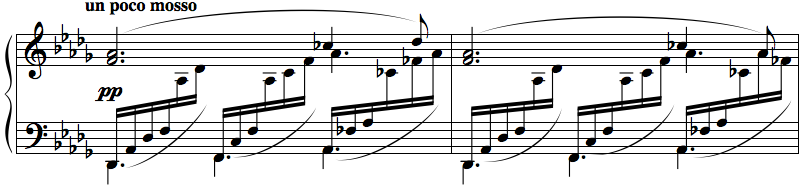
Par AltonTravail personnel, Domaine public, Lien

Looking at these two bars, it is obvious that a scrambling will be less rhythmical, but clearly harmonic. However, this is because they are in the same harmony, only part of the key.

Even so, even four bars or eight bars, the harmonic will outweigh the disharmonic. The main problem would be the irregular rhythm. Arguably, there would also be some irregularity of sequence of harmonies. But it would not sound like Wozzek. In order to sound like Wozzek, unbearable, you need to arrange a sequence of unbearable dissonances. Like, I speak from bad experience (I was trying to make a kind of homage to Stravinsky, it came out more Wozzek, horror of horrors!) pure fourth plus augmented fourth. Very effective Wozzekiser!

So, no, the presumption that simple lack of order, simple chaos, is unbearable to the human mind, is wrong. It is wrong in the domaine of musical appreciation, and it is also wrong in the other domains. Accepting chaos (rather than seeking order) is not the utmost satisfaction of the human mind, but it is also not the horror of horrors. Indeed, it is an art which can be learned. It is a somewhat sluggish art, but it is not an excruciating horror.

This means, using logic to examine questions (including either "where do we come from, where do we go" or any part questions leading up to it) is not giving in to some kind of trauma, it is using the equipment we have for its most noble quest.

It is also simply wrong to think Edmond is not in his own right engaging in this question, since his presumption our thoughts come from our brains and its wiring, and our brains evolved, is part of the evolutionist answer to the question. I think it is the wrong answer, but as that is outside the thing about Clair de Lune, courtesy of Debussy, and its "random scrambling", I'll refer you to another blog:

Creation vs. Evolution
https://creavsevolu.blogspot.com/


Obviously, however, in order to make the exposé about how we have a horror of randomly scrambled notes, Edmond Kirsch had to actually NOT scramble the notes randomly, but use deliberate Wozzek harmonies.

Hans Georg Lundahl
Bibliothèque Louise Michel
St. Matthias Apostle
25.II.2020

* See Origin (Brown novel)
From Wikipedia, the free encyclopedia
https://en.wikipedia.org/wiki/Origin_(Brown_novel)

Sunday, July 14, 2019

Self Promotion : Wikihow : Compose by Schenkerian Synthesis


I got this into my mail:

Hi Hans-Georg Lundahl,

We wanted to let you know that the article Compose by Schenkerian Synthesis that you started on wikiHow has been read more than 1,000 times. Having your article read by so many people is a great accomplishment. Congratulations!

Thanks, again, for making wikiHow a better resource. If you feel like it, help again today by writing a new article!

Sincerely,
The wikiHow Team
http://www.wikihow.com


Nice to hear that, and barring the writing of a new article, at least I am promoting Wiki-How!

Thursday, February 8, 2018

Ceci est métrique en français


Répliques Assorties : "Oh hier, je crois plutôt en hier!" · musicalia : Ceci est métrique en français

Huit lignes sont d'un même mètre, soit octosyllabe par iambe et deux anapestes, soit ceci avec une syllabe ajoutée (si elle est prononcée):

xXxxXxxX(x)
xXxxXxxX
xXxxXxxX(x)
xXxxXxxX
xXxxXxxX
xXxxXxXX
xXxxXxxX(x)
xXxxXxxX

Une fois j'ai même triché, au lieu de la configuration iambe, anapeste et encore un anapeste, le deuxième anapeste est remplacée par un bacchée.

Les autres huit lignes ont des variations d'un octossyllabe autres qu'en haut, en ne pas prenant compte de la dernière syllabe, une fois on a même un ennéasyllabe:

xXxXxXxX (quatre iambes)
xxXxxxXX(x) (un anapeste, un pyrrhique plus un bacchée)
xxxXXxxX(x) (tribrache plus spondée, anapeste - ou quatrième péon et choriambe)
xxXxxXxX(x) (deux anapestes plus un iambe)
xXxXxxxX (deux iambes et un quatrième péon, ou presque quatre iambes=
xXxxXxxxX(x) ! iambe, anapeste et quatrième péon donnent un ennéasyllabe, avant la syllabe éventuellement ajoutée
xxXxxXxX (deux anapestes plus un iambe)
xxXxXxxX(x) (anapeste, iambe, anapeste)

Fort bien. Il y a un genre de chanson française, on peut très bien imaginer une mélodie d'une valse, pour lequel cette variation rhythmique est même très bénéfique.

En lisant le poëme, j'avais l'impression qu'avec une valse, ce serait très bien rhythmique.

Par contre, il y a aussi des mélodies qui sont fait pour des rhythmes plus précises que ça.

Dans lesquels, par exemple, il serait atroce de remplacer même iambe et deux anapestes avec quatre iambes.

Or, le rock et la pop anglaise est parfois comme ceci.

Il y a un homme qui a voulu placer "pour toujours" dans la même fin d'une phrase musicale qui en anglais a un "forever".

Ben non! L'équivalent métrique d'un "pour toujours" est en anglais "evermore", si on prend le même concept à la même place.

Evermore, comme dans le poëme The Raven par E. A. Poe. Mais, avant son poëme, probablement très usité par des traducteurs de poësie française, puisque "evermore" correspond métriquement à "pour toujours".

Ceci n'est pas, mais vraiment pas du tout le cas pour les mots "pour toujours" et "forever".

"Forever" est xXx, amphibrache, et "pour toujours" est au contraire un crétique, XxX, ou un anapeste, xxX.

C'est très évident qu'il va sonner un peu ridicule d'adapter les mots "pour toujours" à la mélodie de "forever".

for-EV-er
pour TOU-jours

On ne dit pas "pour TOU-jours", on dit "pour tou-JOURS". Pareille, une phrase musicale calculée comme ayant une fin féminine va devenir moins rhythmique si on change l'accentuation de la phrase pour en avoir une fin masculine.

Notons, je ne dis pas que "pour toujours" ne puisse pas traduire "forever", mais alors il faut déplacer la phrase "pour toujours" dans la phrase musicale, dans la ligne de texte.

Pour les octosyllabes à quatre iambes (plus communes en anglais qu'en français, qui remplace donc volontier trois iambes par deux anapestes), la phrase "pour toujours" pourra faire les syllabes 2-4, 4-6 et 6-8. Mais "forever" les syllabes 1-3, 3-5, 5-7 (7-9, avec une syllabe ajoutée, alors audible).

Hans Georg Lundahl
BU de Nanterre
St. Jean de Matha
8.II.2018

Thursday, December 14, 2017

Finding Gruber and Origin of Silent Night (Link)


Silent Night: The Origin of the Song
By RTO.org
http://www.returntoorder.org/2016/12/origin-song-silent-night/


Two comments:

  • by some glitch, probably spell check, one suspect having been Michael Haydn, his name was, when I accessed, spelled as "Hadyn", I signalled the glitch and hope they have changed it;
  • one commenter says the story is "apocryphal" : that is the kind of suspicion in historiography I don't like. I am accepting it, until I see a better underpinned one.

Thursday, October 5, 2017

I looked for Johann Sebastian Bach on ancestry.com


Some of you may know my little fad of selecting as large a number of persons as manageable and per case within that possible, from the past, as known by internet profiles.

This is why I looked him up, and on ancestry. Funny enough, I found lots of him on US School records from 1880 to 2013.


Could this explain the phenomena of prodigal productivity and of ... polyphony?/HGL

Thursday, September 14, 2017

Music Theory : I or i, IV (or iv, or ii or II), V (quora)


Q
What is the difference between tonic, subdominant and dominant in music?
https://www.quora.com/What-is-the-difference-between-tonic-subdominant-and-dominant-in-music/answer/Hans-Georg-Lundahl


Hans-Georg Lundahl
Self Employed at Writer and Composer
Answered just now
  • The tonic is the home chord of a composition (the one a Schenkerian analysis will reduce it to), which is stated or implied at the end - same applies to any phrase in it, since these are minor compositions too, it is also its base note;
  • The dominant is one fifth above the tonic, is a major chord, and is the usual chord just before the home chord at the end of a phrase or composition : the reason for its usually being major is that the major third of the dominant is a leading note, leading up to the tonic note;
  • The subdominant does not have a set function, but can replace the dominant in the cadence, thus making it a plagal one, its base note being a leading note to the major third (if such) of the tonic, it can also prepare the dominant, but can also in both capacities be replaced by a major or minor double dominant. It is, essentially, an intermediate.


You can end a composition on tonic in full cadence, or just before tonic, on dominant, in half cadence (meaning you imply, but refuse to actually state the tonic), but you can not very well end it on either subdominant or double dominant, these feeling a bit too intermediate. Transposing a whole phrase that way is another matter, in that case the original subdominant or double dominant of the composition has become the new tonic of the final part of it.

[I am, like some of the other answers, assuming the questioner already can find these on a scale. I am however also more treating them as conventional functions in musical composition rather than as just places in the scale.]

Wednesday, April 5, 2017

England is Still Musical!


Back in the days that the Pen and Pension blog writes about, the English were among the nations most eager to play music at home.

Pen and Pension : Music at Home
Posted on April 5, 2017
https://penandpension.com/2017/04/05/music-at-home/


Georgian England is the England under Kings (or Usurpers) George I to George IV - 1 August 1714 to 26 June 1830 (at the broadest definition, the Pen and Pension blogger might have a narrower one).

This is some time ago, so it is interesting if Englans is still musical.

Judging by this Oxford girl, that is the case:

Why music should be beautiful... Alma's message for Carinthian Summer Press Conference
AlmaDeutscher
https://www.youtube.com/watch?v=7yf_pbVvIWk


She is not just a musician, but also a composer./HGL

Monday, December 5, 2016

Anatole et Malagüeña


Comme on sait, la progression de chordes dite "un anatole" parce que très banale est des chordes:

C-Am-Dm-G

Ou éventuellement avec des septièmes:

C(maj7)-Am7-Dm7-G7

Ensuite, je me cherchais une méthode de la varier un peu moins banale. À savoir, de prendre la chorde Dm et la changer en A♭ :

C-Am-A♭-G

Ceci remplace donc le ré avec son tritonième la bémol, et la quinte descendante ou quarte ascendante dans la fondamentale avec un démiton descendant. Ici aussi, je pourrais imaginer de poivrer avec septièmes, surtout pour éviter les parallèles.

C-Am-A♭7-G7

Et justement ici, ça me frappe, que A♭-G = F-E. La cadence tellement caractéristique d'une Malagüeña.

Je compare donc ...

C-Am-A♭-G

Am-G-F-E

Où exactement est l'origine de la différence? A♭-G = F-E; donc aussi C-A♭ = Am-F, à ceci près que ça commence une fois en majeur et une fois en mineur. Ah ...

C-Am-A♭ = division chromatique de C-A♭

Am-G-F = division diatonique de Am-F.

Et puisque C-A♭ est en soi-même une progression quelque chromatique, et Am-F est en soi-même strictement diatonique, ça tombe bien.

Voici donc la distance d'un anatole à une malagüeña :

  • 1) remplacez la double-dominante avec son triton
  • 2) remplacez la progression de la tonique au triton de la double-dominante de chromatique en diatonique
  • 3) en ce faisant, changez la tonique de majeur en mineur, pour que ça aille mieux en progression diatonique.


C'est tout!

Hans Georg Lundahl
BU de Nanterre
St. Sabbas, Abbé
5.XII.2016

Monday, October 17, 2016

Attempting Schenkerian Analysis of Waltzing Matilda

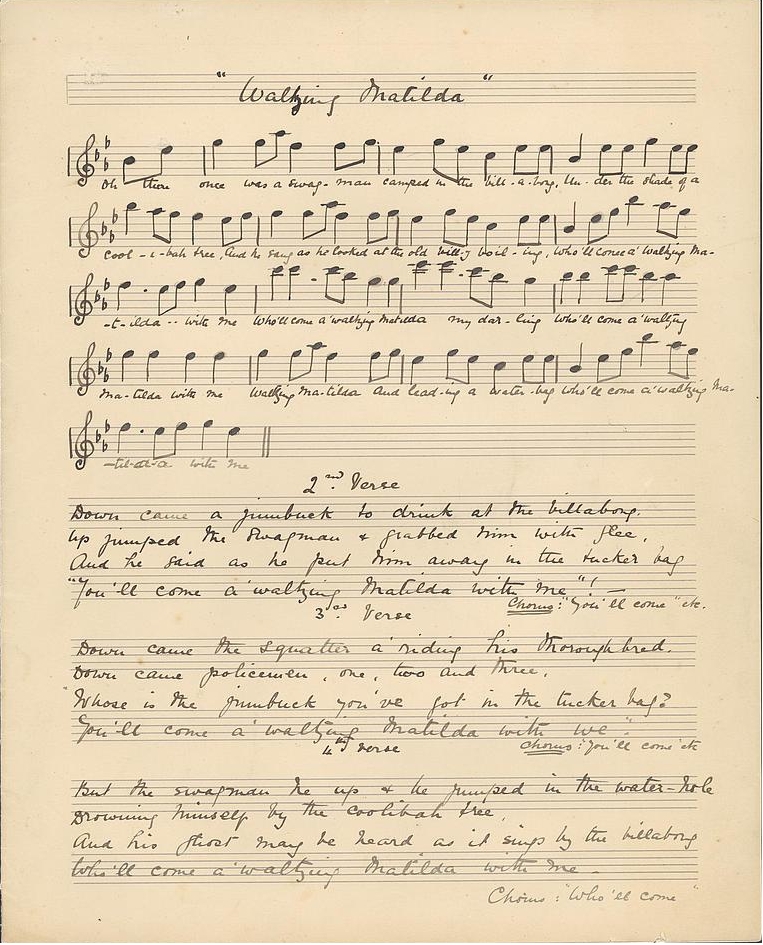
Credits first, melody copied by hand after The original manuscript of "Waltzing Matilda", transcribed by Christina Macpherson c. 1895. uploaded on The Wickipeejuh.


By Christina MacphersonThe original uploader was Brisvegas at English Wikipedia (uploaded 7 June 2008) - National Museum of Australia, Public Domain, Link

Now, here is where I first copy by hand and then analyse: